Renaissance Astrology Home Page SERVICES PAYMENT COURSES BOOKS CONTACT SEARCH Renaissance Astrology Home Page

The Fixed Stars in Renaissance Astrology
Christopher Warnock, Esq.
The Fixed Stars in Renaissance
Astrology and Magic
HOME


Star Field

Astrological Talismans
Talisman of Aldebaran
Talisman of the Wing of Corvus
Talisman of Sirius
Talisman of Algol
Cornelius Agrippa's Images
of the Fixed Stars
Hermes Trismegistus
Hermes on the 15 Fixed Stars
Spiritus Mundi
Subscribe to Spiritus_Mundi
Traditional (pre-1700) Astrology
Discussion Group
Powered by groups.yahoo.com
Renaissance Astrology Links Page
Anne Wright's Fixed Stars Site

Advanced Search
Innumerable as the stars of night,
Or stars of morning, dewdrops which the Sun
Impearls on every leaf and every flower.
Paradise Lost
John Milton


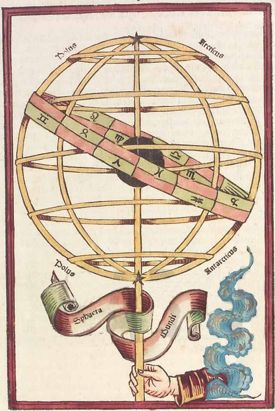
Renaissance astrology used a geocentric (Earth-centered) astronomy based on the concept of planetary spheres. The fastest planet, the Moon had the sphere closest to Earth followed by Mercury, Venus, the Sun, Mars, Jupiter and the slowest and thus highest of the planetary spheres, Saturn. Above the spheres of the planets was the sphere of the fixed stars and the Zodiac, the highest of the celestial spheres. The planets, from the Greek planetos "wanderer" moved relative to the stars of the Zodiacal and extra-Zodiacal constellations which is why they are referred to as the fixed stars.
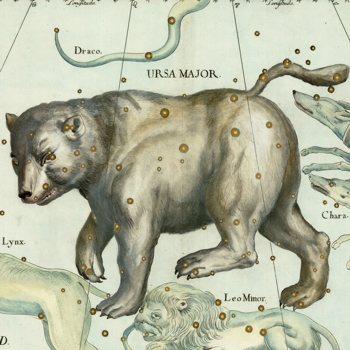
For Renaissance philosophers and astrologers the fixed stars were a key part of the Celestial World, itself the essential link between the Divine World of Ideas and Angels and the Material World. Traditionally each of the fixed stars was part of one of the 12 Zodiacal constellations or 36 extra-Zodiacal constellations. The fixed stars of the Zodiacal constellations were especially important as they comprised the Signs, an essential component of astrology.
Each fixed star was considered to have the attributes of one or more planets. For example, the fixed star Aldebaran, was considered to be of the nature of Mars. Ptolemy Tetrabiblos Bk. I, Chapter 9 (Loeb, 1940) page 47. Anne Wright has an excellent Fixed Stars Web Site which gives much useful information on the nature of the various fixed stars.
Each fixed star was part of individual chains comprising the Great Chain of Being. The Renaissance philosopher and astrologer Marsilio Ficino says,

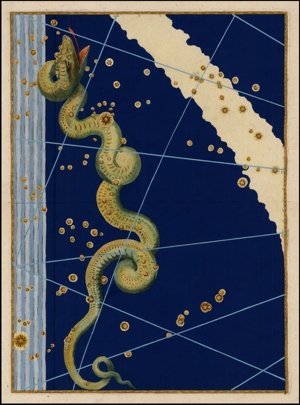
Serpentarius
"I have said elsewhere that down from every single star (so to speak Platonically) there hangs its own series of things down to the lowest...Under the celestial Serpent or the entire constellation of the Serpent-bearer, they place Saturn and sometimes Jupiter, afterwards daemons who often take on serpent's form, in addition men of this kind, serpents (the animals), the snake-weed, the stone draconite which originates in the head of a dragon, and the stone commonly called serpentine...By a similar system they think a chain of beings descends by levels from any star of the firmament through any planet under its dominion. If, therefore, as I said, you combine at the right time all the Solar things through any level of that order, i.e., men of Solar nature or something belonging to such a man, likewise animals, plants, metals, gems and whatever pertains to these, you will drink in unconditionally the power of the Sun and to some extent the natural powers of the Solar daemons."

Ficino, Three Books on Life, Bk. III, Chap. 14, p. 311.
Thus each of the things ruled by a particular planet or star share certain qualities, powers and virtues embodied in a celestial form exemplified by their planetary or stellar ruler. The planet or star, in turn, is the instantiation of one or more Divine Forms or Ideas. Thus everything in the Material World has its origin in the Divine World through the mediation of the celestials.
In Horary Astrology the fixed stars give useful additional information in delineating questions. Here are some examples of horary delineations using the fixed stars: Criminal Case Example, Curse Example and He Got the Job! Example. In Electional Astrology they are most often used in situations requiring permanence. John Partridge says that, "In Foundations of Cities in the first place regard the Fixed Stars, then joyn Benevolent Planets with them." Mikropanastron (London, 1679) Electional Aphorism #21, page 266. For building houses, however, Partridge suggests looking to the planets and signs. Here is an example of a Legal Election using fixed stars, in this case, to debilitate an opponent.

Chiromancy
These are passive uses of the planetary rulerships, where the astrologer merely observes the effects of the chains of correspondence and harmony. In astrological magic the mage or astrological magician makes use of the planetary rulerships to accomplish material effects. By gathering many disparate examples of items under the rule of a particular star we can intensify and focus the quality exemplified by the star, especially if we elect a time when the planet is in strong Zodiacal state and well placed in the horoscope. Here are four examples of astrological talismans using the fixed stars, Talisman of Aldebaran, Talisman of the Wing of Corvus, Talisman of Sirius and Talisman of Algol using the Fixed Star Images from Cornelius Agrippa's Three Books of Occult Philosophy.
For those that desire to delve deeper into Astrological Magic and Astrological Talismans I offer an Astrological Magic Web Course. If you are interested in discussing and learning about Renaissance Astrology, particulary Astrological Magic, you may wish to subscribe to Spiritus Mundi my e-group devoted to traditional (pre-1700) astrology.


TOP

Renaissance Astrology Home Page
HOME


Please Contact me with any Questions & Comments

Specializing in Horary Astrology, Electional Astrology Astrological Magic and Astrological Talismans.

Copyright 2001, Christopher Warnock, All Rights Reserved.