Thabit Ibn Qurra says that....
whoever studies Philosophy and Geometry and all other sciences and is
stranger to Astrology will be hindered or obstructed, because the
most valuable Geometry and highest Philosophy is the science
of Images.
De Imaginibus, "On Images" is, after
Picatrix, the most important text for medieval
and Renaissance astrological magic.
De Imaginibus is accepted as the work of the Harranian
Sabian sage Thabit Ibn Qurra. Written in the 9th century
A.D. and the product of the Neoplatonic and Hermetic wisdom of the Harranian Sabians,
the book was a key source for the Picatrix as well as being consulted by
Albertus Magnus, Marsilio Ficino and
Cornelius Agrippa.
De Imaginibus represents the height of
astrological magic technique and goes far beyond merely planetary talismans in
using the full range of traditional astrological technique developed by the
sophisticated Harranian Sabians. De Imaginibus explains how to create
house based talismans, how to use horary questions to
forecast and anchor talismans and how to tune talismans to individual natal charts.
De Imaginibus is divided in the the
following nine chapters:
On the Expulsion of Scorpions and Other Pests
Example of the Destruction of a City
Images for Receiving Wealth from Another
Images for Profit from your own Efforts
Third Part with Regard to Rulership and Authority
Conversion of the King to Affection or Displaying Fellowship
Fourth Part: Images for Concord and Separation and Love
Between Two People
Summary
The Form in Which the Image is Cast
You can see practial applications and
actual examples of elections here for
Wealth Talismans from De Imaginibus.
Renaissance Astrology is proud to present the first
English translation of Thabit Ibn Qurra'sDe Imaginibus, "On Images". This translation was made from the British Library's
Royal CXVIII manuscript of De Imaginibus and includes an introduction to this
key text of astrological magic and to the Harranian
Sabians, of whom Thabit Ibn Qurra was perhaps the most distinguished philosopher,
translator, scientist and master of the occult arts of astrology and magic.
The Renaissance Astrology edition contains a complete
translation, the shorter paraphrase contained in Cornelius Agrippa's
Three Books of Occult Philosophy plus a commentary
by the translator, Christopher Warnock, a leading
contemporary practitioner of traditional astrological magic. This edition also
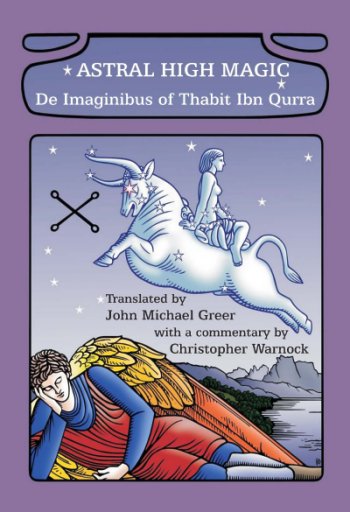
contains beautiful illustrations by the artist and contemporary mage
Nigel Jackson.
The commentary explains not only the practical application
of the teachings of De Imaginibus on the preparation of talismans, but also
the deeper philosophical and spiritual significance of the work, which truly is an
important guide to Hermeticism as a Practical
Path to Gnosis, the mystic union with the Divine.
De Imaginibus
The Renaissance Astrology translation of
De Imaginibus is 64 pages, in 6 inch by 9 inch standard paperback perfect binding.
The cost is $29.95 plus $7.95 priority mail shipping
in the U.S. Please Contact me to order directly by
credit card or for shipping outside the
U.S.
"Study conceives knowledge, but knowledge gives birth to love, love to likeness,
likeness to community, community to strength, strength to worthiness, worthiness
to power, and power makes miracle. This is the sole route to the goal of magical
accomplishment, both divine and natural."-
So wrote our master the wise Abbot Trithemius of
Spanheim and his words seem particularly relevant when reading this splendid
new edition, the first ever English translation with authoritative commentary,
of Thabit Ibn Qurra's seminal work 'De Imaginibus' by our good friend and magical
colleague Christopher Warnock. And this new translation of Thabit is indeed a
tome which provides just such high-calibre material to fuel and sustain the
ongoing process of magical learning and arcane empowerment which Trithemius alludes to.
De Imaginibus' is of special importance to those of us who
are votaries of the traditional schools of Astrology, Magic
and Occult Philosophy as it stems directly from the ancient
lore of the Hermetic sages, magicians and priests of Harran,
that fabulous city of many temples whose ruins are now hidden
beneath the sands of the desert wastes of southern Turkey,
in past ages one of the great centres wherein the Hermetic
tradition was preserved, developed and refined over many centuries
by the initiates.
Therefore this text holds a place of special pre-eminence
and presents a very pure stream of applied Hermetic knowledge which has not
previously been available in English. The publication of this present
edition of 'On Images', transcribed from the medieval Latin of John of
Seville (from the Royal C XVIII Manuscript in the British Library) is
without doubt an event of considerable importance in the esoteric sphere.
De Imaginibus' is elegantly typeset
and clearly designed in a pleasing
layout for easy reading and reference. The quality of the translation is
fluent, easily comprehensible and provides a straightforward and intelligible
rendering of Thabit's sometimes mystical and often technically-detailed exposition.
Translated into a clear and fluent English we are able to appreciate the texture
and nuance of Thabit's teachings and the thought of this great master is at last
made available to the contemporary student.
Comparative translations of
Cornelius Agrippa's paraphrastic condensations of the material in
'De Occulta Philosophia' Book II, Chapter 50 illuminate the manner
in which this material was engaged by the philosopher-magi of the late
Middle Ages and Renaissance as a living current of spiritual practise.
However it is with Christopher's
incisive and comprehensive commentaries,
themselves worth the cover price alone, that we are provided with the keys,
not just to Thabit's work, but to a fuller understanding of the wider spiritual
horizons of Traditional Astrology and Magic, skilfully contextualizing these
materials within the greater mysteries of the Gnosis to which they afford access.
Here we are shown just how the techniques of Astrological Magic, utterly fascinating
and practically utile as they indeed are, are not really ends in themselves, but
in actuality form ascending rungs of the ladder of the Padeia, the initiatory
learning-experience of the Hermetic Tradition, so we can appreciate fully how
the lesser goals inevitably serve and naturally guide the seeker toward the
greater goal of mystical wisdom and union with the Divine.
The methods of
Astrological Magic form carefully gradated steps of ascent from this
sublunary sphere toward the ultimate realisation of the Anth
ropos Teleieos, the Perfect Human. Christopher very ably presents
and unfolds the practical methodology of 'De Imaginibus' within the
framework of this majestic spiritual vision, a numinous awareness
which pervades the commentaries as an authentic spiritual discourse
along the lines of initiatory understanding which Thabit himself clearly intends.
Thus the text is certainly very scholarly
but goes far beyond the rationalistic
scope of conventional academic study as it is actually intended to be studied
and engaged by those who seek to orientate themselves within the numinous
world-view of the tradition. These commentaries glitter with many profound
insights and great erudition throughout, a superb exposition which gives
the reader a very firm grounding in the foundations of the traditional
magical mind-set. So the book is, as well as a specific translation and
commentary on Thabit's text, also a reliable point of access to the
traditional understanding of Astrology and Magic and should be required
reading for anybody seeking to explore these subjects.
For what is involved
is nothing less than a transformed perception of the universe and our
spiritual relation to it's arcana. This book is a genuinely authoritative exploration
of the theoretical and practical bases of Traditional Astrological Magic.
Thabit's astrological methods in
'De Imaginibus' really exemplify the Art at
its most mature, complex and sophisticated levels of application, primarily
house-based rather than simply planetary/dignity-based, and thus the talismanic
techniques he instructs us in are finely attuned to horary and electional
charts to create specific effects in accord with the intent of the Magus.
It really requires a practitioner possessing a true mastery of Traditional
Astrology to effectively explain and illuminate the intricacies of Thabit's
teachings - Christopher is eminently qualified in this respect to explicate
these ideas and make them accessible and useable to us.
The range of Thabit's
magical instructions is extremely goal-motivated and results-orientated,
detailing the creation of images to expel pests and vermin, malefic geomantic
magic to ruinate and destroy cities, wealth-magic for increase of prosperity,
profit, establishing authority and dominion, gaining favour and preferment
of kings, classic love-magic and also operations to bring discord and seperation.
We are shown exactly how Thabit is setting up the necessary elections and given a
sound understanding of the principles underlying these various magical operations.
It is our great good fortune at this
time that we have a master-mentor in
Christopher Warnock capable of unfolding the practical techniques of the
'De Imaginibus' as well as illuminating the wider spiritual sphere this knowledge
opens up onto. Here we see the technical Hermetica leading by successive steps to
the austere and sublime mysteries of the phuliosophical Hermetica. After many
centuries Thabit Ibn Qurra's technical teachings and the truly mystical tenor
of his thought alike are both done justice in this magisterial new edition of
the 'De Imaginibus'. The true 'Sons of Hermes' and 'Daughters of Sophia'
in this age can be grateful at this precious work being made available to us
for our spiritual study and practise...