
|
TALISMANS | READINGS | COURSES | BOOKS | CDs | SOFTWARE | POSTERS | PAYMENT | CONTACT | SEARCH |

|
| Christopher Warnock, Esq. |
| HOME |

|




Al-Biruni
Introduction
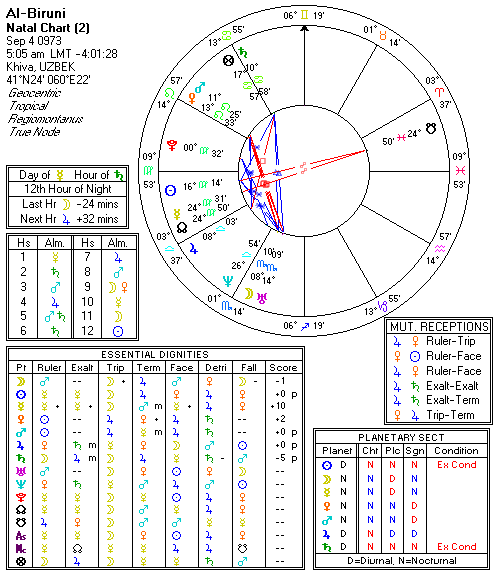
Al-Biruni's Horoscope
Al-Biruni and Astrology
The great medieval Islamic scientist and astrologer Abu'l-Rayhan Muhammad Ibn Ahmad Al-Biruni was born in 973 A.D. in Kath, then capital of the Principality of Khwarizm, the present day city of Khiva in Uzbekistan. From a young age he undertook serious scientific research and study, publishing a treatise on cartography at the age of 22. Al-Biruni wrote over a hundred books and treatises on such varied subjects as mathematics, geometry, geography, astronomy, astrology, the density of minerals and history.

|

|
Al-Biruni, despite being a medieval Islamic astrologer, remains a significant source for students of Renaissance astrology. The fall of Rome and the onset of the Dark Ages saw the virtual extinguishment of astrology in Europe. Much classical learning was preserved in the sophisticated Islamic civilization of the Middle East and knowledge in many fields, including astrology, was materially advanced by scientists and philosophers like Al-Biruni. Medieval and Renaissance astrology is essentially Islamic astrology, a fact that is easily ascertained by noting the large number of Islamic sources quoted by William Lilly in the bibliography to his Christian Astrology or the many references made to Islamic authors by the Italian astrologer Guido Bonatti in his Liber Astronomiae.
On a more profound level it is useful for the student of Renaissance astrology to study the works of Islamic authors like Al-Biruni because the milieu in which they worked and thought was one in which unity was paramount. This belief is expressed fundamentally as tawhid the unity of God, but expresses itself also in a unified schema of knowledge, where science, theology and mysticism are not contradictory, but all part of the unity and harmony of all existence. Here is an interesting article on Islamic science by Dr. Seyyed Hossein Nasr.
|
|
One thing we might note is the prominence of Mercury. As Virgo rises, Mercury is the ruler of the Ascendant and with Gemini on the cusp of the tenth house Mercury also rules Al-Biruni's reputation and career.
Despite the affliction of being Under the Sun's Beams (though leaving) Mercury is well placed in the angular first house and extremely well dignified by sign, exaltation and face as well as being closely conjunct the benefic North Node of the Moon.
Lilly notes that a native with a well-dignified Mercury is,
"[A]n excellent disputant or Logician, arguing with learning and discretion, and using much eloquence in his speech, a searcher into all kinds of Mysteries and Learning, sharp and witty, learning almost any thing without a Teacher; ambitious of being exquisite in every Science, desirious naturally of travel and seeing foraign parts: a man of an unwearied fancy, curious in the search of any occult knowledge; able by his own Genius to produce wonders; given to Divination and the more secret knowledge..."
Christian Astrology, page 77.
We are fortunate to have a English translation by R. Ramsay Wright of Al-Biruni's Kitab al tafhim li awa'il sina'at al tanjim, the Book of Instructions in the Elements of the Art of Astrology, often known as the Tafhim. The astrological section of the Book of Instructions is available on Amazon and the complete Book of Instructions is available in pdf on my Renaissance Astrology CD Library III. Al-Biruni follows a logical progression from first principles and begins with geometry, then goes onto to arithmetic, astronomy, geography, chronology and a discussion of the use of the astrolabe before reaching his introduction to astrology.

|
|
|
|

Book of Instructions Order at Amazon! |
"The comprehension of the structure of the Universe, and of the nature of the form of the Heavens and the Earth and all that is between them, attained by rehearsing the information received is extremely advantageous in the Art of Astrology...I have begun with Geometry and proceeded to Arithmetic and the Science of Numbers, then to the structure of the Universe and finally to Judicial Astrology, for no one who is worthy of the style and title of Astrologer who is not thoroughly conversant with these for sciences."
Book of Instructions, page 1.
Al-Biruni does occasionally criticize certain astrological techniques and he is skeptical of astrologers of the Hashwiyite school, but no where in the Book of Instructions does he indicate any skepticism regarding astrology in general. Instead Al-Biruni presents astrology, the science of astral influences, as a logical and necessary part of Islamic philosophy and science. Here is a selection from the Book of Instructions containing of Al-Biruni's tables of the the things assigned to each of the 12 houses.

HOME
For Order and Other Information please Contact me.
Copyright 2012, Christopher Warnock, All Rights Reserved.